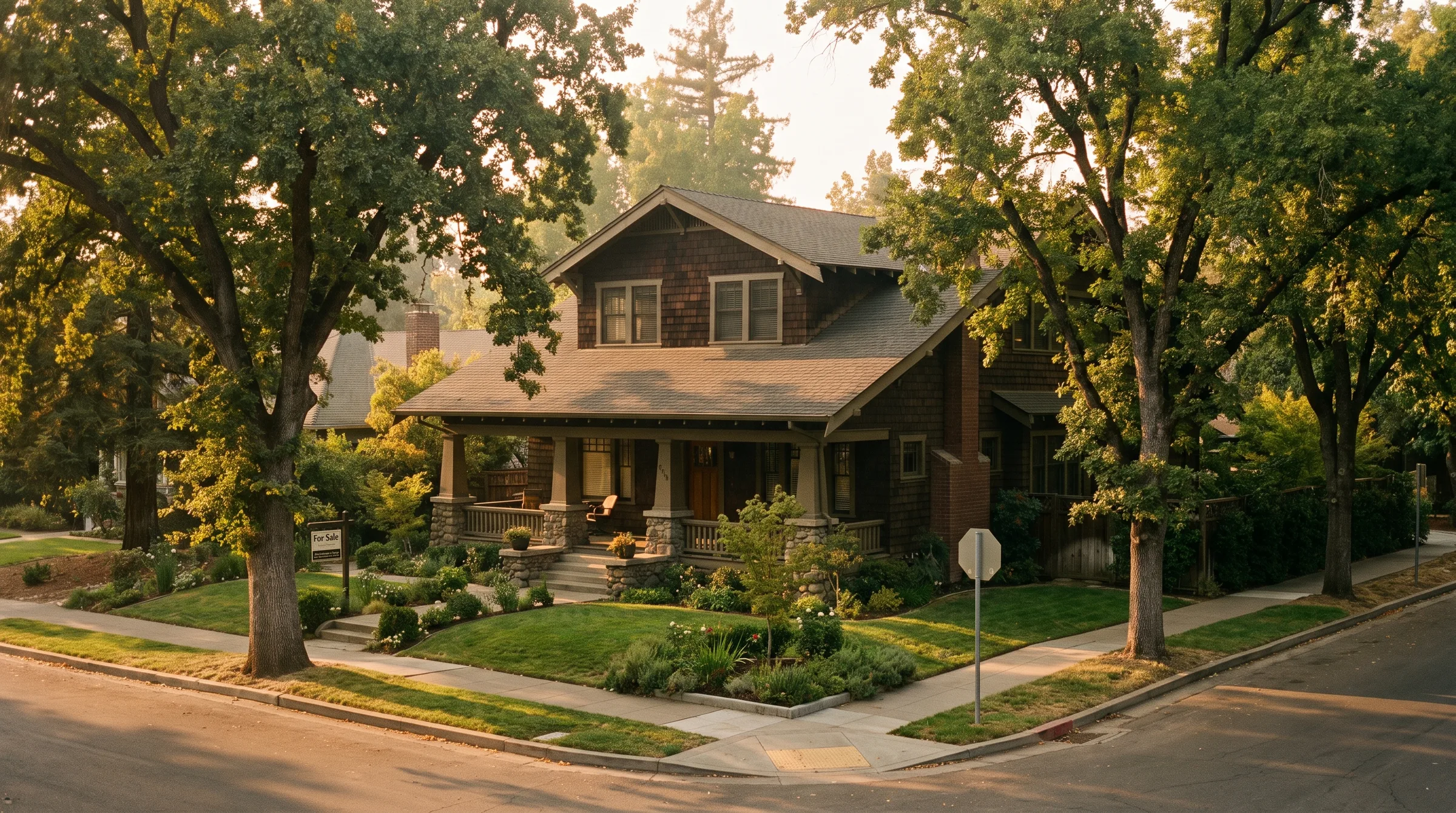


Sell a house without a surprise tax bill in Del Paso Heights
A clean cash sale that works with the estate, the attorney, and the court. Close on your timeline.

Licensed, verified, and reviewed by Sacramento sellers.
Every credential below links to the proof: the license, the filings, the certifications. The reviews are from real sellers on Google.
4.832 Google reviewsRead the Google reviews
On this page · 9 sections
- 01What a Del Paso Heights heir really owes when selling an inherited house
- 02How stepped-up basis works on an older north-area home
- 03Why waiting can quietly create the bill you were trying to avoid
- 04Selling a house in probate in Del Paso Heights without stalling the estate
- 05What the local price picture means for your tax math
- 06Your realistic options for an inherited Del Paso Heights house
- 07Condition issues common to postwar Del Paso Heights homes
- 08State rules, Prop 19, and the people you should ask
- 09How a direct sale to Darren fits around your attorney and the court
When you own a house without a surprise tax bill in Del Paso Heights, a direct sale is often the fastest way out. Darren B. Brown buys inherited and probate homes as-is for cash and works alongside your attorney and the court. Homes around Del Paso Heights tend to sell below the regional median, and Darren will give you a fair, no-obligation number either way.
- Sacramento-area median sale price (mid-2026)
- $585,000
- Typical time on market for a listed home
- 33 days
- Darren can close in as few as
- 10 days
Stepped-up basis is your friend
Because an inherited home is generally valued at the date-of-death market value, selling soon after often means little taxable gain. Waiting years while it appreciates can create a larger bill.
How selling to Darren works
1. Tell Darren about the property
Call (916) 300-7962 or request an offer online. It takes a few minutes and there is no obligation.
2. Get your offer
Darren reviews the home and makes a fair, no-obligation cash offer, usually within 24 to 48 hours.
3. Close on your date
Pick the closing date that works for you. Darren covers standard closing costs and handles the rest, so you simply collect your proceeds.
What you skip when you sell direct
- No repairs, cleaning, or cleanouts
- No agent commissions or listing fees
- No showings or open houses
- No financing contingencies that fall through
- Close on the date you choose
- Works alongside your attorney and the court
About Del Paso Heights
A modest, older north-area neighborhood of small postwar homes seeing steady reinvestment. Homes here (95815, 95838) are largely 1940s-1960s, and they tend to sell below the regional median. Darren buys across Del Paso Heights in any condition.
What a Del Paso Heights heir really owes when selling an inherited house
If you inherited a house in Del Paso Heights and are worried about a big capital gains bill, the honest answer is that it is usually far less than people expect, especially when you sell close to the date of death. That is because of something called stepped-up basis, and understanding it is the single most useful thing you can do before deciding what to do with the property.
Most heirs come to this the same way. A parent or grandparent bought a small postwar house in 95815 or 95838 decades ago, maybe for a price that sounds impossible now. The family assumes the whole difference between that old purchase price and today's value will be taxed. In most inherited situations, that is not how it works. The tax clock generally resets to the home's market value on the date your loved one passed.
I'm Darren B. Brown. I have been buying houses directly from Sacramento-area owners since 1996, I'm a licensed California broker (DRE #01295232), and I'm a retired Air Force veteran. I'm not a tax advisor, and nothing here replaces your CPA. What I can do is explain how the timing of a sale interacts with stepped-up basis, and how a direct, as-is sale can keep that window working in your favor.
How stepped-up basis works on an older north-area home
Stepped-up basis means an inherited home is generally valued at its date-of-death market value, so if you sell soon afterward, there is often little taxable gain. Your gain is measured from that stepped-up figure, not from what your family paid in the 1950s or 1970s.
Think about a typical Del Paso Heights house: a modest one-story built somewhere between the 1940s and 1960s, on a lot that has watched the north area change around it. If it was bought long ago, the original price may be a tiny fraction of its current value. Without the step-up, that gap would be a serious tax problem. With it, the starting line moves up to roughly what the house was worth when it passed to you. The IRS explains basis rules in IRS Publication 551 on basis, and your tax professional can apply it to your family's exact facts.
The catch is that the step-up is a snapshot in time. It does not move forward with the market. Every month the house appreciates after the date of death is potential gain that belongs to you, not to the step-up. That is why so many tax advisors tell heirs that a sooner sale often means a simpler return. For a broader overview across the region, I've written about capital gains on an inherited house in Sacramento.
Why waiting can quietly create the bill you were trying to avoid
Holding an inherited house for years while it appreciates can turn a small or nonexistent gain into a larger one. Del Paso Heights has been seeing steady reinvestment, and that is good news for the neighborhood, but it also means value can climb after the step-up date.
Families rarely plan to wait. It just happens. One sibling wants to keep it as a rental, another wants to fix it up first, the attorney is still working through the estate, and nobody wants to be the one who pushes. Meanwhile the house sits, the yard grows, and the gap between today's value and the date-of-death value keeps widening. When the sale finally happens, the gain that would have been close to zero may not be anymore.
There is also the carrying cost of waiting: insurance on a vacant house, utilities, property taxes, and the worry about a break-in or a roof leak nobody notices. None of that shows up as a tax line, but it eats into what the heirs actually receive. The IRS Topic 409 on capital gains covers how gains on property are generally treated, and it is worth reading before you decide to hold.
Selling a house in probate in Del Paso Heights without stalling the estate
You can sell a house in probate in Del Paso Heights, and a direct buyer who works with your attorney and the court can keep the sale from becoming the slowest part of the estate. I coordinate with the personal representative, the attorney, and whatever the court requires, rather than asking the family to manage it alone.
Probate real estate in Del Paso Heights has its own texture. Many of these homes have been in one family for a generation or more. Some have permitted additions and some have additions nobody remembers permitting. Some still have the original wiring or a detached garage that has become storage for fifty years of belongings. A traditional buyer with a lender often balks at exactly those things, and a financing contingency that falls through can push the whole estate timeline back.
Because I buy as-is for cash, those issues become my problem instead of a reason to restart. Your attorney can focus on the legal steps while I handle the property side. If you want the specifics of court timing and paperwork, my page on selling a house during probate in Del Paso Heights walks through it, and recorded documents for the property can be looked up through the Sacramento County Clerk-Recorder.
What the local price picture means for your tax math
Homes around Del Paso Heights tend to sell below the regional median, and that matters when you think about gains. The Sacramento-area median sale price was $585,000 in mid-2026, and a small 1950s house in 95838 often lands under that figure, which keeps the dollar size of any post-step-up appreciation more modest.
That is not a reason to be careless, though. Even a below-median home can appreciate meaningfully over a few years in a neighborhood seeing reinvestment. The question is not whether your house is expensive. The question is how far today's sale price sits above the date-of-death value, and how much of that you would give up to selling costs if you listed.
A listed home in the area typically sits on the market around 33 days, and that is before escrow. I can close in as few as 10 days when the paperwork allows. For heirs trying to stay close to the step-up value, that shorter window can be meaningful. Families in neighboring areas face the same math with different housing stock, which I cover for inherited homes in North Highlands and for the newer subdivisions in Natomas inherited property sales.
Your realistic options for an inherited Del Paso Heights house
Heirs in Del Paso Heights generally have three paths: keep the house, list it with an agent, or sell it directly as-is. Each one has real trade-offs, and the right answer depends on the family, the condition of the home, and how much time and money everyone wants to put in.
Keeping it can make sense if someone will live there or wants a long-term rental and the family agrees. Listing can bring a strong price if the house is in good shape and the heirs can handle repairs, cleanouts, showings, and a buyer's inspection list. A direct sale trades some of that top-line potential for speed, certainty, and no work. I give a fair, no-obligation number either way, so you can compare it honestly against what listing might net after commissions and repairs.
Here are questions worth settling as a family before you choose:
Do all heirs agree on selling, and who has authority to sign?
Has anyone obtained a date-of-death valuation for the house?
Would repairs on a 1940s to 1960s home pay for themselves before sale?
How much will holding the house cost each month until it sells?
Has your CPA reviewed whether a sooner sale changes your tax picture?
Condition issues common to postwar Del Paso Heights homes
Many inherited houses here need work, and you do not have to fix any of it to sell to me. Small postwar homes built in the 1940s through the 1960s tend to share the same aging items, and those items are often what derail a conventional sale.
Older roofs, original plumbing, dated electrical panels, settled foundations, and kitchens that were last updated decades ago are all common. So are full households of belongings: tools in the garage, furniture in every room, and paperwork tucked into closets. Clearing and repairing all of that can take months and real money, and every month of delay is more time for appreciation to accrue past the step-up date.
I buy across Del Paso Heights in any condition, which means the family can take what matters to them and leave the rest. That is often the moment heirs tell me they finally feel relief. If you want more on the non-tax side of handing off a family home, see my guide to selling an inherited house in Del Paso Heights.
State rules, Prop 19, and the people you should ask
California adds its own layer, so check both federal and state rules with a professional before you decide. Your CPA or tax preparer is the right person to confirm whether your gain is small, and the California Franchise Tax Board handles the state side of income tax.
Property taxes are a separate question from capital gains. Families sometimes consider keeping a parent's house to hold onto a low assessed value, and Proposition 19 changed how that works for many transfers between parents and children. The Board of Equalization explains it in its Prop 19 guide. I won't tell you how it applies to your situation, because that depends on facts your advisor should review, but it is worth understanding before anyone decides to hold.
If you want a plain-language summary of the state picture, I've written about capital gains tax on inherited property in California. The goal is not to make you a tax expert. It is to help you ask the right questions so the house decision and the tax decision line up.
How a direct sale to Darren fits around your attorney and the court
A direct sale works best when it supports the estate's process instead of competing with it. I work alongside your attorney and the court, so the sale moves when the legal side is ready, and you choose the closing date that fits.
You tell me about the house, I look at it and make a fair cash offer, usually within 24 to 48 hours, and I cover standard closing costs. There is no middleman or national buyer passing your file along. You are dealing with one local person who has been doing this in the Sacramento area for more than 30 years and who answers his own phone.
If you're sitting on a Del Paso Heights house and wondering whether the taxes will sting, call me at (916) 300-7962. I'll give you an honest number, explain how it compares to listing, and encourage you to run it past your CPA. You can also browse my overview of probate and inherited home sales or the local page on probate home sales in Del Paso Heights before we talk. Either way, there is no obligation.